Best Clubs to Buy for Beginners: Start Your Golf Journey Right
Choosing the right first set of golf clubs is the single most important equipment decision a new golfer makes. This guide breaks down exactly which clubs to buy, why they help, and how to build a beginner bag that grows with your game.
EXPLORE THE GUIDEWhy this guide matters: Most beginners overthink their first purchase and end up with clubs that are too demanding for their swing. The right starter set is forgiving, easy to launch, and matched to your current skill level. Below you will find clear, tier-based recommendations so you can buy with confidence and get on the course faster.
What Makes a Golf Club Beginner-Friendly?
Beginner clubs are engineered around a simple principle: help the golfer get the ball airborne and moving forward, even when contact is imperfect. Three design features do most of the work. First, perimeter weighting moves mass to the edges of the clubhead, which stabilizes the face on off-center strikes. Second, a low and deep center of gravity launches the ball higher without requiring a perfect downward strike. Third, larger clubheads and wider soles create a bigger effective sweet spot and reduce digging into the turf.
Grip size and shaft flex also matter more than most beginners realize. A shaft that is too stiff for your swing speed drains distance, while a grip that is too thin or too thick harms control. If you are still building your swing, see our guide to golf equipment fundamentals before committing to a full purchase.
Complete Beginner Sets vs. Buying Clubs Individually
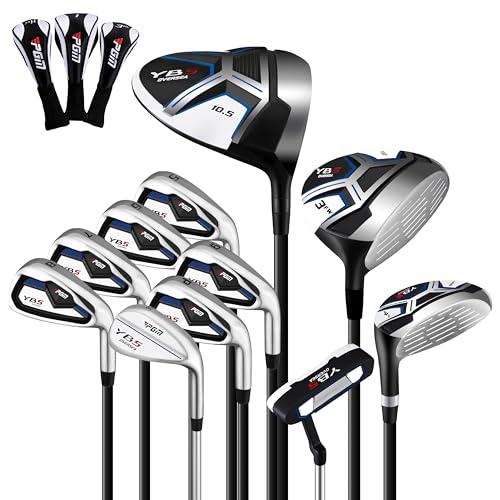
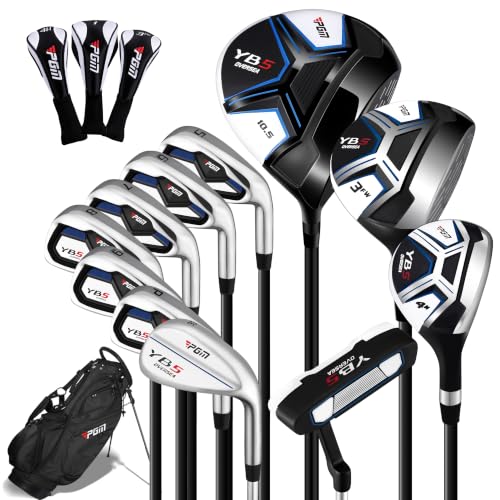
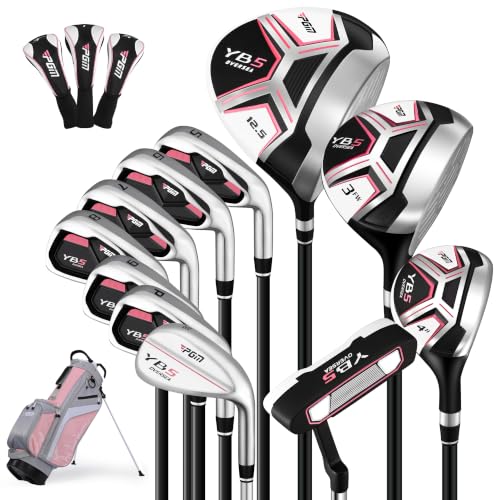
There are two main paths into the sport, and both are valid depending on your goals. A boxed beginner set is the fastest, most consistent route: every club is pre-matched in shaft, grip, and swing weight, so you learn with a coherent bag rather than a random assortment. These sets typically include a driver, a fairway wood or hybrid, several irons, a wedge, and a putter, plus a bag.
Buying individually gives you more control but requires more research. It also opens the door to used golf clubs, which let you try the sport with lower commitment before upgrading. If you already know you will play regularly, a matched new set is usually the better long-term foundation. If you are still deciding whether golf is for you, a quality beginner-to-intermediate club set can carry you further than a bare-bones starter package.
The Driver: Distance With Forgiveness
The driver is the club beginners most want to master and often the one that causes the most frustration. A beginner-friendly driver prioritizes forgiveness over low-spin performance. Look for a high-lofted head in the mid-range category, which helps get the ball airborne with a slower swing speed, and a rear or draw-biased weight that reduces the slice that plagues most new players.
A premium driver with a movable weight system can add shot-shaping flexibility later, but the mid-range tier already delivers more than enough technology for a beginner. If you want a deeper dive on head design and adjustability, read our breakdown of adjustable drivers and the best drivers for distance and forgiveness. The goal at this stage is simple: a club you can hit reasonably straight most of the time.
Fairway Woods and Hybrids: The Beginner's Secret Weapon
If there is one category where beginners gain the most immediate improvement, it is hybrids. A hybrid blends a fairway wood head with an iron-length shaft, producing a club that launches high, cuts through rough, and is far more forgiving than a long iron. Most beginner sets include at least one hybrid for exactly this reason.
Fairway woods round out the top of the bag. A forgiving 3-wood or 5-wood gives you a reliable option off the tee and from the fairway on long holes. Beginners often find these clubs easier to control than a driver early on. Our guide to the best fairway woods for beginners and the best hybrids for high handicappers cover the specific designs that suit developing swings. For golfers with slower swings, a fairway wood built for slow swing speed can be a game-changer.
Irons: Game Improvement Is Your Friend
Irons make up the engine room of the bag, and for beginners the correct category is unequivocally game improvement irons. These feature a deep cavity back, perimeter weighting, and a wide sole that resists digging. The result is higher launch, more ball speed on mishits, and a noticeably larger sweet spot compared to players irons or blades.
A beginner does not need a full set of eight irons. A practical setup is mid-irons (6 and 7), short irons (8 and 9), and a pitching wedge, with hybrids filling the long-iron gaps. If you want the full picture of iron categories, read our guide to the most forgiving irons for high handicappers and the best forgiving golf irons available. Beginners should avoid blade irons and players irons entirely until their ball striking becomes consistent.
Wedges: Short-Game Foundations
Wedges are where beginners gain strokes fastest, yet they are the most neglected part of a starter bag. A beginner-friendly wedge has a wide sole and generous bounce, which prevents the club from digging on fat contact and makes bunker escapes far easier. A pitching wedge from your iron set is a fine starting point, but adding a dedicated sand wedge or a versatile gap wedge pays immediate dividends around the green.
Our guide to the best wedges for mid to high handicappers explains bounce and grind in plain language. If you are building a left-handed bag, the 60-degree left-handed lob wedge is worth a look for greenside versatility, though most beginners should master a sand wedge before adding a lob wedge. For short-game technique that pairs with the equipment, see our short game fundamentals and short game tips.
Putters: Where Consistency Wins
Putting is where beginners can genuinely match experienced players, and the equipment choice is straightforward. A mallet putter is the better first choice for most new golfers because its high moment of inertia resists twisting on off-center strikes and its alignment aids are more prominent. Blade putters offer more feel but demand a repeatable stroke that beginners have not yet developed.
Length and grip matter as much as head shape. A putter that is too long forces an upright, unnatural posture, while the wrong grip size kills feel. A proper putter fitting guide walkthrough will help you match the club to your body and stroke. Do not overlook the essential golf equipment around the putter either, including alignment aids and practice tools that build repeatability.
How to Build a Beginner Bag: A Practical Setup
A sensible beginner bag does not need 14 clubs. Start with a core that covers every distance you realistically face: a driver, one fairway wood or hybrid, mid and short irons, a pitching wedge, a sand wedge, and a putter. That is roughly nine to eleven clubs, and it is more than enough to learn the game and post a score.
As your swing improves, fill the gaps. Add a hybrid to replace a long iron, a gap wedge to close the distance between pitching and sand wedge, and a lob wedge once your short game demands it. Readers who want a complete overview of bag composition should read the guide to the best clubs to have in your golf bag. Left-handed beginners have dedicated options too, covered in the best clubs for left-handed golfers guide.
Beginner Club Tiers: Entry-Level, Mid-Range, and Premium
Beginner clubs fall into three broad quality tiers. Understanding them helps you buy at the right level without overcommitting.
- Entry-level: Boxed complete sets and budget-friendly individual clubs. These use standard forgiveness technology and are ideal if you are brand new and unsure how often you will play.
- Mid-range: Game improvement iron sets and forgiving drivers from established brands. This is the sweet spot for most beginners, offering noticeably smoother performance and better build quality than entry-level without the specialized demands of premium gear.
- Premium: High-end adjustable drivers, forged game improvement irons, and tour-inspired wedges. These reward consistent players and are best considered after you have developed a repeatable swing.
Keep the tiers in mind as you shop. A mid-range driver paired with a mid-range game improvement iron set will serve a beginner better than a single premium club surrounded by budget equipment.
Buying Advice: What Beginners Should Prioritize
When comparing beginner clubs, prioritize forgiveness, loft, and shaft flex over tour-level features. A higher-lofted driver and a regular or senior-flex shaft will do more for your game than an adjustable weight track. For irons, cavity-back game improvement designs beat players irons every time at this stage. For putters, alignment and stability beat feel.
If you plan to purchase used equipment, buy from reputable sellers and check grip condition and shaft integrity. Used clubs are a smart way to try specific models before committing. For broader equipment strategy, our golf equipment hub ties together clubs, balls, and accessories. Once you have your clubs, a golf school for beginners accelerates progress far faster than trial and error on the range.
Frequently Asked Questions
What golf clubs should a beginner buy first?
Start with a complete set that includes a driver, fairway wood or hybrid, mid and short irons, a wedge, and a putter. A boxed beginner set is the easiest entry because the clubs are pre-matched for consistency.
Are game improvement irons good for beginners?
Yes. They feature perimeter weighting, a larger sweet spot, and a low center of gravity that helps beginners launch the ball higher and straighter with forgiveness on mishits.
Do beginners need a driver or can they start with a hybrid?
Many beginners find early success with hybrids and fairway woods. A driver belongs in the bag, but beginners can tee off with a hybrid while building swing confidence.
How many clubs should a beginner carry?
You do not need all 14. A starter setup of a driver, one fairway wood or hybrid, five to seven irons, a wedge, and a putter covers the shots most new golfers face.
Should beginners buy new or used golf clubs?
Both work. Used clubs lower your initial commitment, while new beginner sets come pre-matched with current forgiveness technology and warranty support.
Final Thoughts
Buying the best clubs for beginners is not about spending the most. It is about matching forgiveness, loft, and shaft flex to a developing swing. A driver you can hit straight, a hybrid that rescues bad lies, game improvement irons that launch the ball, a wide-soled wedge, and a stable mallet putter make up a bag that will help any new golfer improve faster. Start with the mid-range tier, add clubs as your game grows, and let the equipment work with your swing instead of against it.