Golf Balance Trainers: Improve Stability & Swing Power
Enhance your weight transfer, core stability, and overall swing consistency with the right balance training aid. Learn how balance boards and wobble trainers can transform your game.
Why balance matters in golf: A stable base is the foundation of every great swing. Without it, even the best swing fundamentals break down under pressure. Balance trainers are specifically designed to challenge your proprioception, helping you develop the body control needed to repeat a consistent, powerful motion hole after hole.
Why Balance Is the Hidden Key to Lower Scores
During the golf swing, your weight shifts dynamically from address to the top of the backswing and then aggressively into the downswing. If you can’t stabilize that movement, you’ll sway, slide, or lose your spine angle — common faults that kill both distance and accuracy. A dedicated balance trainer conditions your nervous system and core muscles to hold a strong, centered position throughout the swing. Regular practice not only ingrains golf fitness improvements but also translates directly into tighter dispersion and more solid strikes.
Types of Golf Balance Trainers
Wobble Boards
A circular or rectangular board with a rounded base underneath. Excellent for developing ankle stability and subtle weight shifts, mimicking the lateral motion of the golf swing.
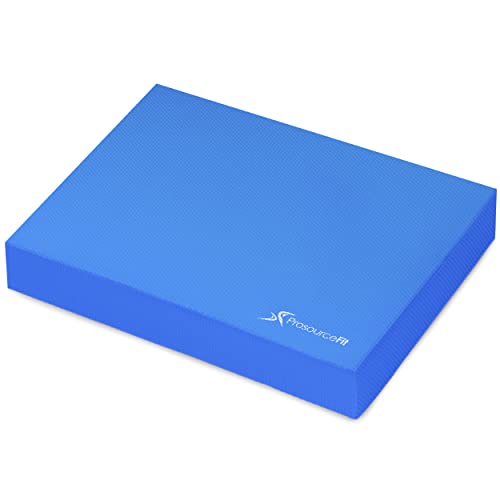
Balance Discs / Cushions
Inflatable, air‑filled cushions that create an unstable surface. Ideal for standing drills, single‑leg holds, and even seated core work. Highly portable and widely used in golf‑specific core training programs.
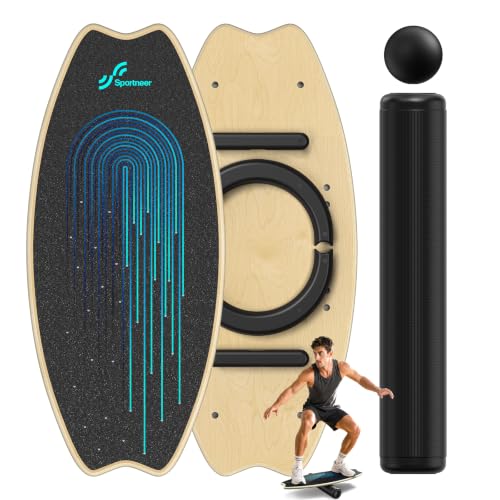
Rocker & Roller Boards
These combine a flat deck with a cylindrical roller underneath, allowing side‑to‑side and front‑to‑back motion. They demand precise body control and are superb for advanced balance and weight‑transfer drills.
BOSU®‑Style Trainers
A half‑stability ball mounted on a rigid platform. You can use it dome‑up or dome‑down for endless exercise variations, from standing balance holds to dynamic squat rotations that mirror the swing.
Key Benefits of Adding a Balance Trainer to Your Routine
- Improved Weight Transfer – Rehearse the smooth shift from trail side to lead side without losing control, a cornerstone of powerful ball striking.
- Enhanced Core Engagement – An unstable surface forces your deep stabilizers to fire continuously, building the kind of functional strength that protects your back and generates clubhead speed.
- Better Posture Retention – Learn to maintain your proper posture even when fatigued, reducing the tendency to stand up or dip during the downswing.
- Injury Prevention – Stronger stabilizer muscles around the ankles, knees, and hips decrease the risk of common golf strains and overuse injuries.
- Increased Body Awareness – Heightened proprioception helps you feel exactly where your body is in space, making swing adjustments much easier to implement.
How to Choose the Right Balance Trainer
With so many options on the market, selecting the best training aid for your needs comes down to a few practical considerations. Beginners should start with a wider, more stable base like a balance disc or a large wobble board, while advanced players can challenge themselves with roller boards or BOSU trainers. Look for a non‑slip top surface, a durable construction that supports at least 250 lbs, and a size that fits your practice space. Portability is a bonus if you plan to warm up at the range or travel with your gear.
Simple Balance Exercises to Start Today
- Two‑Footed Balance Hold – Stand on the trainer with feet shoulder‑width apart, knees slightly bent. Hold for 60 seconds, then repeat with eyes closed to increase difficulty.
- Single‑Leg Stance – Lift one foot off the surface and hold for 30 seconds per side. This mimics the finish position of your swing and builds crucial ankle stability.
- Mini Squats – While balanced on both feet, perform slow, controlled squats. Keep your back straight and weight centered — just as you would during your swing setup.
- Rotational Reaches – Holding a light medicine ball or golf club, rotate your torso side to side while staying balanced. This integrates core rotation with stability, a perfect dynamic warm‑up before a round.
- Eyes‑Closed Challenge – Any of the above exercises becomes exponentially more effective when performed blind, forcing your body to rely entirely on internal feedback.
Consistency is key. Even 5–10 minutes of balance work three times a week can deliver noticeable improvements in your swing control and overall athleticism on the course.