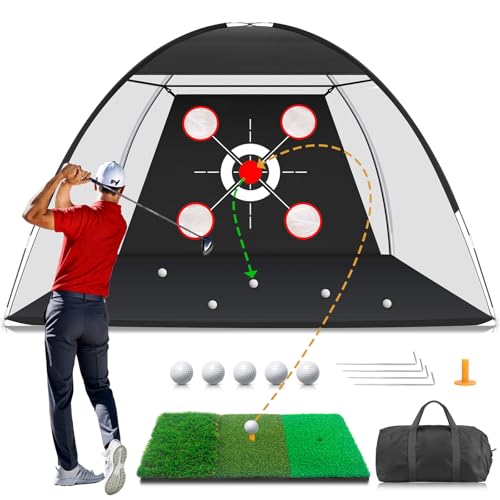
Golf Practice Nets: Complete Guide to Backyard & Indoor Net Training
Everything you need to know about choosing and using a golf practice net for effective swing improvement at home, in your garage, or in the backyard.
VIEW RECOMMENDED NETSPractice Net Philosophy: A quality golf practice net combined with a reliable hitting mat and a personal launch monitor can transform any space into your own driving range. The right net safely contains your shots, gives you the freedom to experiment, and keeps your swing sharp between rounds.
Whether you’re a beginner building a consistent swing fundamentals routine or an experienced player fine-tuning ball striking, a practice net is one of the most valuable investments you can make. Instead of driving to the range, you can walk into your garage or backyard and start hitting balls. But with so many types, sizes, and materials on the market, how do you pick the right one? This guide breaks down everything you need to know, from pop-up nets to heavy-duty cages, so you can confidently choose a net that matches your space, swing speed, and training goals.
Types of Golf Practice Nets
Pop‑Up Nets
Lightweight, collapsible, and set up in seconds. Perfect for small spaces, apartments, or quick practice sessions. Most include a target or ball‑return channel. Best for irons and moderate swing speeds; heavy driver use may require additional anchoring.
Cage / Frame Nets
Built with sturdy steel or fiberglass frames and high‑impact netting. The large hitting area and enclosed design safely handle full driver swings at high speeds. Many models are compatible with golf simulators and launch monitors, making them a favorite for serious home setups.
Retractable Ceiling‑Mounted Nets
Ideal for garages or indoor rooms where floor space is precious. The net pulls down when you’re ready to hit and retracts out of the way when not in use. Excellent for creating a simulator setup without a permanent footprint.
Hitting Bay / Net & Mat Combos
All‑in‑one kits that bundle a net, frame, and hitting mat. Designed for beginners who want a complete home practice setup in one purchase. Often include side barriers for extra safety.
Key Features to Consider
- Size & Coverage: Make sure the net is tall and wide enough to catch errant shots. A minimum of 7 ft height and 8 ft width is recommended for full swings, especially with driver.
- Netting Material & Durability: Look for high‑density polyester or nylon netting with reinforced double‑stitching. If you swing above 100 mph, opt for heavy‑duty mesh rated for high‑impact balls.
- Frame Stability: Steel frames offer the most stability outdoors; fiberglass is lighter but still robust. Check that the net can be anchored (stakes or sandbags) to prevent tipping in wind or from repeated shots.
- Portability & Storage: Pop‑up and collapsible frames are easy to carry and store. Permanent cage nets require dedicated space but provide a more professional feel.
- Indoor vs Outdoor Use: Outdoor nets need UV‑resistant materials and weatherproofing. Indoor nets should have a quieter, softer netting and be compatible with practice golf balls to reduce noise.
- Ball Return & Target Features: Automatic ball‑return systems or integrated target sheets can make practice more efficient and fun.
- Launch Monitor Compatibility: If you plan to use a launch monitor, choose a net with minimal metallic interference and enough depth for the device to read ball flight. A simulator‑ready net often has a flat, taut surface to improve radar or camera accuracy.
How to Choose the Right Practice Net for Your Space
Start by measuring your available area. A garage with 9‑ft ceilings can accommodate most cage nets; a small balcony suits a compact pop‑up. Consider your swing speed: faster swingers should invest in a reinforced cage. Budget also plays a role—entry‑level pop‑up nets can be found for $40–$80, mid‑range frame nets typically run $150–$300, and premium retractable or simulator‑grade systems can cost $400–$800+. If you value portability, a lightweight pop‑up is ideal; if you want a permanent driving range feel, a cage net with a dedicated hitting mat is the way to go.
How to Get the Most Out of Your Practice Net
Warm‑Up & Drills
Always begin with a dynamic warm‑up to prevent injury. Use alignment sticks on the ground to ensure your body and clubface are square to the target line. Work on specific swing positions—half‑swings, punch shots—before moving to full speed.
Full‑Swing Practice
Alternate between clubs. Hitting a driver into a net demands extra attention to ceiling height and net stability; always confirm your net is rated for driver speeds. Without ball flight, focus on quality of contact and swing path. Many golfers use impact bags alongside a net for instant feedback on strike.
Launch Monitor Integration
Pairing your net with a launch monitor turns it into a data‑driven training station. You can analyze club speed, ball speed, launch angle, and more. This setup is the closest you’ll get to a golf simulator without a massive budget. Just be sure your net fabric doesn’t block the monitor’s radar or camera signals.
Safety & Maintenance
Inspect the net regularly for fraying or tears, especially if used outdoors. Replace worn sections promptly. Keep a safe distance behind the net—balls can ricochet if they hit the frame. Never aim toward windows, cars, or people.
Frequently Asked Questions
Can I hit a driver into a practice net?
Yes, provided the net is designed for high‑speed impacts. Look for heavy‑duty cage nets with double‑layer mesh and a sturdy frame. Always ensure you have at least 9–10 ft of ceiling clearance and that the net is securely anchored. If you’re a high‑speed player, consider a net specifically marketed as driver‑safe.
What size net do I need for a garage?
The ideal garage net height matches your ceiling height minus a safety margin. For standard 8‑9 ft ceilings, a 7‑8 ft tall cage or a retractable net works well. Width should be at least 8 ft to catch off‑center shots. Measure your space carefully before ordering.
Do I need a special mat to use with a practice net?
A good hitting mat protects your joints and simulates real turf feel. Cheap mats can lead to wrist or elbow pain. Look for a mat with a realistic fairway‑style surface and enough thickness to absorb impact without slipping.
Can I use a launch monitor with any net?
Most radar‑based monitors work well as long as the net isn’t excessively metallic and you have enough ball flight (usually 8‑10 ft). For best results, refer to our launch monitor comparison and choose a net with a flat, non‑reflective surface. Some simulator‑specific nets are designed to minimize interference.
Whether you’re building a full‑fledged home practice setup or simply want a portable net to keep your swing grooved, the right practice net is a game‑changer. Use the criteria above to narrow down your options, then browse the recommended nets below. Each model has been selected to deliver durability, safety, and excellent value for your training needs.