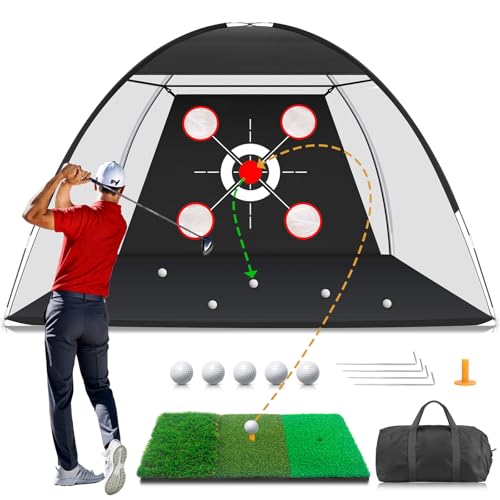
Golf Practice Net with Hitting Mat: Your Complete Home Practice Solution
Transform your backyard or garage into a personal driving range. Discover the best nets and mats for real ball feedback, durability, and easy setup.
VIEW RECOMMENDED NETSWhy a Practice Net? A quality golf practice net with hitting mat lets you work on your swing mechanics, ball striking, and consistency without leaving home. Combined with the right mat, you can practice full swings, chips, and pitches safely.
Whether you’re looking to groove a new swing change, warm up before a round, or simply hit balls during the off‑season, a golf practice net with a hitting mat is one of the best investments you can make. To explore more practice solutions, visit our practice nets hub or our hitting mats guide. In this guide, we break down every aspect—from net types and mat thickness to portability and setup—so you can choose the perfect home practice station.
Types of Golf Practice Nets
Pop‑Up Nets
Lightweight and collapsible, pop‑up nets set up in seconds and are ideal for small backyards or indoor use. They typically feature a spring‑steel frame and durable netting.
Frame Nets
Built with a sturdy metal or fiberglass frame, these nets offer superior stability and can handle high‑speed shots. Many include side barriers for safety.
Cage‑Style Nets
A full enclosure—top, sides, and back—provides maximum protection. Perfect if you worry about shanked shots or have limited space with windows nearby.
Target & Chipping Nets
Smaller nets designed for short game practice. Some models offer multiple target pockets to improve accuracy with wedges and irons. Also check our chipping nets guide.
Why a Hitting Mat Matters
A quality hitting mat isn’t just about protecting your lawn—it simulates real turf interaction. Look for:
Thickness & Cushioning
Mats with 15–25 mm foam reduce shock on joints and mimic fairway lies. A too‑thin mat can lead to wrist or elbow pain over time.
Durable Turf Surface
Nylon or polypropylene grass fibers withstand thousands of swings. A tight weave prevents club snagging and offers a realistic divot feel.
Alignment Guides
Many mats include printed lines or target shapes to help you align your stance and clubface consistently.
Portability
If you need to store the mat after each session, a foldable or roll‑up design is essential. Some mats even have carrying handles.
Key Features to Consider When Buying
- Net Size: At least 7–8 feet wide and 6–7 feet tall for driver practice. Smaller nets work for irons but limit follow‑through.
- Material Durability: High‑density knotless netting resists fraying. Double‑stitched seams add years of life.
- Frame Strength: Fiberglass or steel poles with reinforced connectors. Pop‑up nets rely on memory steel, which is fine for moderate swing speeds.
- Mat Dimensions: A hitting area of 5 x 4 feet or larger gives enough room for full driver swings. Larger mats (5 x 5 ft) allow for stance adjustments.
- Assembly & Storage: If you plan to take the net down often, a pop‑up or quick‑fold frame is best. Permanent backyard setups can use heavier cage nets.
- Safety Features: Side nets or baffles prevent stray balls. A target sheet reduces direct net stress and shows impact point.
Pros of a Home Practice Net
- Convenient daily practice
- Real ball feedback with any club
- Safer than hitting into a fence
- Works indoors (garage) or outdoors
- Often portable for travel
Potential Drawbacks
- Cannot see full ball flight
- Limited feedback on shot shape
- Requires enough ceiling height indoors
- Cheap nets wear out quickly
- Needs a quality mat to protect joints
How to Set Up Your Practice Net & Mat
Proper setup maximizes safety and practice quality. Follow these steps:
1. Choose Level Ground
Place the net on a flat, stable surface—grass, concrete, or garage floor. A slight slope can affect alignment.
2. Secure the Net
Use the included ground stakes (outdoors) or sandbags/weights if on a hard surface. A gust of wind shouldn’t topple it.
3. Position the Mat
Set the hitting mat at a distance that allows a full, unimpeded swing—typically 3–5 feet from the net, depending on your club length.
4. Check Clearances
Ensure there is no valuable or fragile object behind the net. Allow at least 3 feet of space behind the net for ball deceleration.
Remember, consistent practice with a net improves muscle memory and confidence. Pair it with a structured training plan, and you’ll see on‑course results faster. Ready to build your home driving range? Check out our top recommended golf practice net and hitting mat combos below.