
Best Golf Clubs for Intermediate Players: Complete Buying Guide
You’ve moved past the beginner stage and now you’re looking for clubs that match your growing skills. Our comprehensive guide helps you choose the right driver, irons, hybrids, wedges, and putter to lower your scores and increase consistency.
VIEW RECOMMENDED CLUBSWhy this guide matters: As an intermediate golfer, you need equipment that balances forgiveness with workability. The clubs that helped you break 100 may be holding you back from breaking 90 or 80. We’ll explain exactly what to look for, how much to spend, and which types of clubs will give you the best chance to improve.
What Defines an Intermediate Golfer?
Intermediate players typically have a handicap between 10 and 20, a consistent swing tempo, and a solid understanding of course management. You’re no longer fighting a slice on every drive, but you still need forgiveness on off‑center hits. At this stage, the right golf clubs can help you hit more greens, add distance, and gain confidence on the course.
Your ideal set should include:
- Forgiving driver with adjustable loft to fine‑tune trajectory and spin.
- Game‑improvement or players irons that offer distance and a mid‑level workability.
- Hybrids or high‑launch fairway woods to replace long irons and boost consistency from the rough.
- Versatile wedges with the right bounce to handle different turf conditions.
- A putter that fits your stroke – blade or mallet depending on your arc.
Drivers & Fairway Woods for Mid‑Handicap Players
The driver is your most important scoring club. For intermediate players, an adjustable driver is a game‑changer because it allows you to dial in the launch angle and spin rate as your swing evolves. Look for a head with moderate forgiveness (neither ultra‑game‑improvement nor pure player’s) and a shaft that matches your tempo. A professional driver fitting can unlock an extra 15–20 yards without changing your swing.
Fairway woods and hybrids round out the top end of the bag. A fairway wood with a low center of gravity is excellent for second shots into par‑5s, while a hybrid can replace your 3‑ or 4‑iron and make long approach shots much easier. Many intermediate golfers benefit from carrying at least one hybrid – they are simply easier to launch high and land soft.
Choosing the Right Irons: Game Improvement vs. Players Irons
Your iron set will be your most significant investment. Intermediate golfers typically fall into two camps: those who still want maximum help (game improvement irons) and those who are ready for more control (players irons). Read our detailed iron fitting guide to understand the differences, but here’s a quick breakdown.
Game improvement irons feature wider soles, stronger lofts, and perimeter weighting. They launch the ball higher and go farther, which is ideal if your swing speed is moderate or you struggle with consistent contact. Models like the TaylorMade Stealth or Callaway Rogue ST Max are perfect examples.
If you consistently hit the center of the face and want more shot‑shaping ability, consider players irons. These have smaller heads, thinner top lines, and less offset. They won’t forgive mishits as much, but they reward a solid strike with a penetrating ball flight and precise distance control. Popular choices include the Titleist T‑Series or Mizuno JPX 923 Forged.
Not sure which path to take? A blended set (also called a combo set) mixes forgiving long irons with more precise short irons. Many intermediate players find this the perfect compromise. Explore complete iron sets to see how manufacturers package these options.
Wedges and Putters: The Scoring Clubs
Improving your short game is the fastest way to lower your scores. A well‑chosen wedge setup can save you strokes around the green. Intermediate players should carry at least three wedges: a pitching wedge (part of the iron set), a gap wedge (around 50–52°), and a sand wedge (54–56°). Many also add a lob wedge for flop shots and short‑sided misses. Pay close attention to wedge bounce – higher bounce helps in soft sand and fluffy lies, while lower bounce is better for tight fairways.
On the green, your putter is used for about 40% of your strokes. The best intermediate putter is one that suits your natural stroke. If you have a straight‑back‑and‑through motion, a face‑balanced mallet putter will provide more stability. If you have an arcing stroke, a blade putter with toe‑hang feels more natural. A putter fitting analyzes your alignment, impact, and roll – it’s one of the most underrated ways to shoot lower numbers.
The Role of Shafts and Why Custom Fitting Matters
As you progress, the shaft becomes just as important as the clubhead. The right shaft weight, flex, and kick point can dramatically affect your launch, spin, and dispersion. Our shaft selection guide walks you through steel vs. graphite and how to match flex to your swing speed. Generally, intermediates with driver swing speeds over 95 mph should use stiff flex, while those between 80‑95 mph do well with regular flex.
Investing in a fitting session is the single best equipment decision an intermediate golfer can make. Many retailers offer driver fitting and iron fitting for free with club purchase. Even a basic lie‑angle adjustment can reduce your left‑right misses significantly.
Should You Buy a Complete Set or Build Your Own?
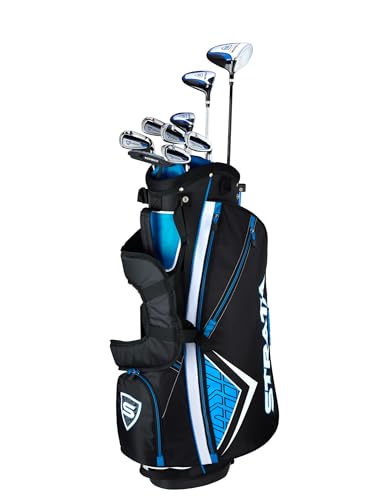
For beginners, complete club sets are often the easiest route. As an intermediate, however, you’ll benefit more from selecting each club based on your specific needs. A custom‑built bag ensures that your driver matches your speed, your irons match your strike pattern, and your wedges suit your course conditions. That said, if you prefer simplicity, there are excellent intermediate‑oriented sets that offer premium components without the guesswork – just make sure they allow for some customization (shaft options, grip size).
For further guidance, see our comparison of the best irons for beginner to intermediate golfers and our review of the best club sets for beginners to intermediate players – these models bridge the gap beautifully.
How Much Should Intermediate Golf Clubs Cost?
Realistic price expectations (per club/category):
- Driver: $400–$600 for a current‑model adjustable driver; previous‑year models often sell for $250–$350.
- Fairway woods / hybrids: $200–$300 each.
- Iron set (4‑PW): $800–$1,400 for game improvement irons; $1,000–$2,000 for players irons.
- Wedges (each): $130–$180.
- Putter: $200–$400 for premium models.
- Full 14‑club set: $1,500–$3,000 depending on brands and custom options.
You don’t need to spend top dollar – many intermediate players assemble a high‑performing bag for around $1,200–$2,500 by mixing current and prior‑generation clubs.
Your Intermediate Club‑Buying Checklist
- Get fitted for at least your driver and irons – it’s free with many purchases.
- Choose a driver with adjustable loft and a shaft that fits your speed and tempo.
- Select irons that match your strike consistency: game improvement for help, players for control, or a blended set.
- Carry a hybrid or two instead of long irons for easier launch and stopping power.
- Pick wedges with the right bounce for your typical course conditions.
- Test multiple putters to find the one that sets up square to your eye and rolls the ball end‑over‑end.
- Don’t overlook the shaft – a well‑fit shaft is just as critical as the clubhead.
- Set a total budget and prioritize the clubs you use most (driver, putter, wedges).
With the right gear, you’ll hit more fairways, find more greens, and shave strokes off your handicap. The clubs you choose now should not only fix today’s misses but also allow your game to keep growing. For more expert advice on club selection and strategy, explore our complete tips section.
![PGF Men's Gold TP Complete Golf Club Package Set [11-Pieces] [Hand: Right] [Length: Standard]](https://m.media-amazon.com/images/I/51wyIJhWbAL._SL500_.jpg)


![PGF Men's Gold Tour Precision Hybrid Golf Club [RH][# 8]](https://m.media-amazon.com/images/I/4118k8BJ64L._SL500_.jpg)

