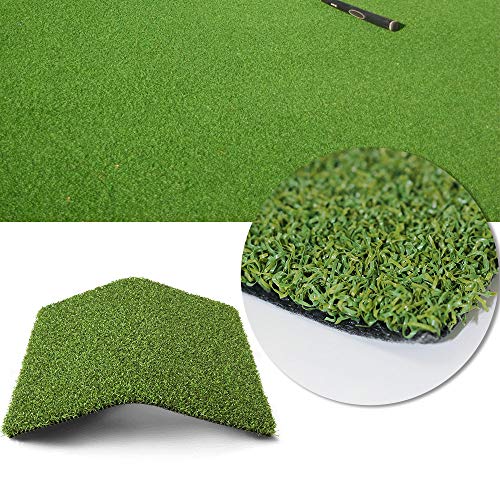
Best Artificial Turf for Outdoor Putting Green
Learn how to choose the right synthetic turf for a backyard putting green that rolls true, lasts for years, and performs like a real course surface—without the maintenance.
Why turf selection matters more than you think. A putting green is only as good as the surface you install. The wrong turf will produce inconsistent ball roll, flatten under foot traffic, and fade in the sun within a few seasons. The right turf—matched to your climate, usage, and performance expectations—can deliver professional-grade practice conditions for well over a decade [citation:10][citation:17].
Nylon vs Polyethylene vs Polypropylene: Which Fiber Belongs on a Putting Green?
The fiber material is the single most important decision you will make. It determines ball-roll fidelity, durability, and how the surface feels underfoot. Not all synthetic fibers are created equal, and the differences are especially pronounced on a putting surface where precision is everything [citation:17].
| Fiber Type | Best For | Ball Roll Quality | Durability |
|---|---|---|---|
| Nylon (Texturized) Premium | Primary putting surface | Excellent—closest to real bent grass | High; 15+ years with UV stabilization |
| Polyethylene (PE) Mid-Range | Fringe, chipping zones, landscaping | Low-to-moderate; too soft for true roll | Moderate; 8–12 years typical |
| Polypropylene (PP) Entry-Level | Casual practice, low-traffic areas | Moderate; degrades under heavy use | Low-to-moderate; 5–8 years in sun |
Why Nylon Wins for Putting Surfaces
Nylon fibers have a memory that other synthetics lack. Press a nylon turf sample with your thumb and release—the fibers snap back upright almost instantly. That resilience is what keeps the surface uniform putt after putt, season after season. Nylon also handles UV exposure better than polypropylene and resists matting under repeated foot traffic, which is critical for a green you actually practice on [citation:9][citation:17].
Texturized nylon takes this a step further. The texturizing process creates micro-variations along each fiber that mimic the grain of natural bent grass, producing a roll that feels responsive rather than mechanical [citation:17].
Where Polyethylene Fits
Polyethylene is softer, looks more natural, and comes in multi-tone blends that replicate real grass beautifully. That makes it an excellent choice for the fringe and chipping areas surrounding your putting surface. But for the putting surface itself, polyethylene is too soft—the ball tends to nestle into the fibers rather than roll across them, killing consistency [citation:17].
The Specifications That Separate a Real Putting Green from Expensive Carpet
Once you have settled on nylon for the putting surface, the next step is understanding the numbers on a turf spec sheet. These five specifications determine whether your green plays like a practice facility or a frustration machine.
- Pile Height: Target 3/8" to 1/2", with 7/16" being the sweet spot. Shorter fibers deflect less on ball contact, producing more predictable forward roll. Anything over 1/2" introduces meaningful speed variation [citation:17].
- Face Weight: Look for at least 36 oz/sq.yd. Below that threshold, there aren't enough fiber ends per square inch to create a uniform contact surface, and the ball catches bare spots inconsistently [citation:17].
- Stitch Rate: A minimum of 14 stitches per inch contributes to surface stability and density [citation:8].
- Backing System: A permeable backing that drains efficiently is essential. Waterlogged turf becomes uneven, algae-prone, and unusable. Premium backings also reinforce the fibers against heavy foot traffic [citation:5][citation:11].
- UV Stabilization: Outdoor turf lives in the sun. UV inhibitors protect against fading and fiber brittleness. Look for turf tested to withstand thousands of hours of accelerated weathering [citation:1][citation:4].
Infill: The Speed Knob You Can Adjust After Installation
Infill is the granular material brushed between the turf fibers. On a putting green, it serves three purposes: it holds the blades upright, shields them from being crushed underfoot, and acts as the primary speed-control mechanism. More infill generally means a faster, firmer surface; less infill produces a slower roll [citation:13].
Fine silica sand is the standard for putting greens. It settles into the turf evenly, supports the fibers, and delivers the firm footing a true roll requires without choking drainage. Rounded or coated sand is preferable to raw, jagged sand, which can wear down the fibers over years of use [citation:13].
If you want to dial in a specific stimp reading—say, matching the speed of your home course—infill depth is how you do it. Start with less, test the roll, and add gradually. This is far easier than swapping turf later [citation:17].
The Installation Foundations You Cannot Skip
Even the best turf will fail on a poorly prepared base. For an outdoor putting green, two elements are non-negotiable: a compacted, level sub-base and proper drainage.
A gravel or crushed aggregate base, compacted in layers, provides stability and prevents soft spots from developing under foot traffic [citation:10]. Without it, your green will develop uneven areas that make a true roll impossible, and correcting the problem later means tearing everything out.
Drainage needs to be planned before the turf goes down. A slight surface slope of 1–2% helps shed water, and permeable turf backing allows water to pass through. In rainy climates or on flat lots, a subsurface drainage system may be necessary to prevent pooling beneath the surface [citation:13].
If you are handy and comfortable with excavation and compacting, a DIY installation is achievable. But if the base prep sounds daunting, professional installation is worth the investment—a putting green is a long-term project, and shortcuts in the foundation show up quickly [citation:10].
Quick Buyer's Checklist
- Putting surface: Texturized nylon, 3/8"–1/2" pile height, 36+ oz/sq.yd face weight
- Fringe/chip zone: Polyethylene turf for a natural look and softer feel
- Infill: Fine silica sand, applied in stages and brushed in
- Backing: Permeable, with drainage capacity matched to your climate
- UV protection: Explicitly stated on the spec sheet, not assumed
- Base: Compacted aggregate, leveled and sloped for drainage
Frequently Asked Questions
Ready to build your backyard practice green? Start with the right turf, prepare the base properly, and you will have a surface that rewards every practice session with honest feedback and a true roll.